
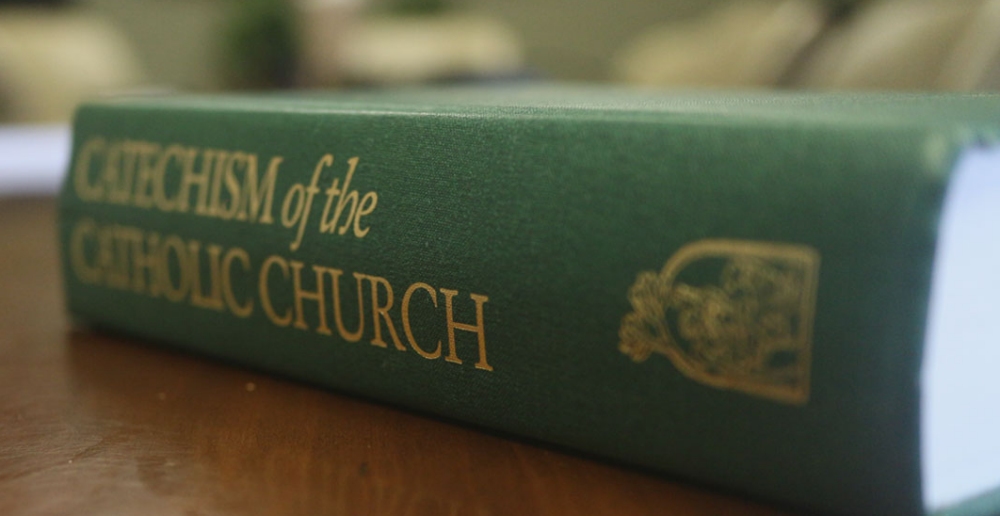
The Catechism of the Catholic Church (often abbreviated as CCC) is the official, comprehensive summary of the Catholic faith, presenting the Church’s doctrines, teachings, and moral guidelines in a structured format. It was first promulgated by Pope John Paul II on October 11, 1992, following the Second Vatican Council (1962–1965), and serves as a reference for bishops, priests, catechists, and laypeople worldwide. The text is divided into four main parts:
- The Profession of Faith: Explains the Creed, covering beliefs in God, Jesus Christ, the Holy Spirit, the Church, and the sacraments.
- The Celebration of the Christian Mystery: Focuses on the liturgy and the seven sacraments (Baptism, Confirmation, Eucharist, Penance, Anointing of the Sick, Holy Orders, and Matrimony).
- Life in Christ: Discusses morality, the Ten Commandments, virtues, sin, and social justice.
- Christian Prayer: Covers forms of prayer, the Lord’s Prayer, and the role of prayer in Catholic life.
It draws from Scripture, Church Fathers, ecumenical councils, and papal teachings, aiming to foster unity and catechesis (religious instruction). Use link below to access the CCC on the Vatican website:
Who will be saved?
CCC content to follow
Further reading – extract from the dogmatic constitution ‘Lumen Gentium’ https://www.vatican.va/archive/hist_councils/ii_vatican_council/documents/vat-ii_const_19641121_lumen-gentium_en.html
All men are called to be part of this catholic unity of the people of God which in promoting universal peace presages it. And there belong to or are related to it in various ways, the Catholic faithful, all who believe in Christ, and indeed the whole of mankind, for all men are called by the grace of God to salvation.
This Sacred Council wishes to turn its attention firstly to the Catholic faithful. Basing itself upon Sacred Scripture and Tradition, it teaches that the Church, now sojourning on earth as an exile, is necessary for salvation. Christ, present to us in His Body, which is the Church, is the one Mediator and the unique way of salvation. In explicit terms He Himself affirmed the necessity of faith and baptism and thereby affirmed also the necessity of the Church, for through baptism as through a door men enter the Church. Whosoever, therefore, knowing that the Catholic Church was made necessary by Christ, would refuse to enter or to remain in it, could not be saved.
They are fully incorporated in the society of the Church who, possessing the Spirit of Christ accept her entire system and all the means of salvation given to her, and are united with her as part of her visible bodily structure and through her with Christ, who rules her through the Supreme Pontiff and the bishops. The bonds which bind men to the Church in a visible way are profession of faith, the sacraments, and ecclesiastical government and communion. He is not saved, however, who, though part of the body of the Church, does not persevere in charity. He remains indeed in the bosom of the Church, but, as it were, only in a “bodily” manner and not “in his heart. All the Church’s children should remember that their exalted status is to be attributed not to their own merits but to the special grace of Christ. If they fail moreover to respond to that grace in thought, word and deed, not only shall they not be saved but they will be the more severely judged.
Catechumens who, moved by the Holy Spirit, seek with explicit intention to be incorporated into the Church are by that very intention joined with her. With love and solicitude Mother Church already embraces them as her own.
The Church recognizes that in many ways she is linked with those who, being baptized, are honored with the name of Christian, though they do not profess the faith in its entirety or do not preserve unity of communion with the successor of Peter. For there are many who honor Sacred Scripture, taking it as a norm of belief and a pattern of life, and who show a sincere zeal. They lovingly believe in God the Father Almighty and in Christ, the Son of God and Saviour. They are consecrated by baptism, in which they are united with Christ. They also recognize and accept other sacraments within their own Churches or ecclesiastical communities. Many of them rejoice in the episcopate, celebrate the Holy Eucharist and cultivate devotion toward the Virgin Mother of God. They also share with us in prayer and other spiritual benefits. Likewise we can say that in some real way they are joined with us in the Holy Spirit, for to them too He gives His gifts and graces whereby He is operative among them with His sanctifying power. Some indeed He has strengthened to the extent of the shedding of their blood. In all of Christ’s disciples the Spirit arouses the desire to be peacefully united, in the manner determined by Christ, as one flock under one shepherd, and He prompts them to pursue this end. Mother Church never ceases to pray, hope and work that this may come about. She exhorts her children to purification and renewal so that the sign of Christ may shine more brightly over the face of the earth.
Finally, those who have not yet received the Gospel are related in various ways to the people of God. In the first place we must recall the people to whom the testament and the promises were given and from whom Christ was born according to the flesh. On account of their fathers this people remains most dear to God, for God does not repent of the gifts He makes nor of the calls He issues. But the plan of salvation also includes those who acknowledge the Creator. In the first place amongst these there are the Muslims, who, professing to hold the faith of Abraham, along with us adore the one and merciful God, who on the last day will judge mankind. Nor is God far distant from those who in shadows and images seek the unknown God, for it is He who gives to all men life and breath and all things,and as Saviour wills that all men be saved. Those also can attain to salvation who through no fault of their own do not know the Gospel of Christ or His Church, yet sincerely seek God and moved by grace strive by their deeds to do His will as it is known to them through the dictates of conscience. Nor does Divine Providence deny the helps necessary for salvation to those who, without blame on their part, have not yet arrived at an explicit knowledge of God and with His grace strive to live a good life. Whatever good or truth is found amongst them is looked upon by the Church as a preparation for the Gospel. She knows that it is given by Him who enlightens all men so that they may finally have life.