The concept of ‘Original Sin’
The Catechism of the Catholic Church (CCC) discusses original sin in the section titled “The Fall” (Part One, Section Two, Chapter One, Article 1, Paragraph 7), specifically in paragraphs 385-421. The core teaching on original sin is found in paragraphs 402-409, emphasizing that it is a consequence of Adam’s sin transmitted to all humanity, resulting in a state of deprivation rather than a personal act. Below is a structured summary of the key teachings, drawn from the official text.
Key Teachings on Original Sin
- Connection to Adam’s Sin: The Church teaches that the overwhelming misery, inclination toward evil, and death experienced by humanity stem from Adam’s sin. This sin has been transmitted to all people, afflicting them from birth as the “death of the soul.” Adam received original holiness and justice not just for himself but for all human nature. By yielding to temptation, Adam and Eve committed a personal sin that affected human nature, transmitting it in a fallen state.
- Nature of Original Sin: Original sin is called “sin” in an analogical sense—it is a contracted state, not a committed act. It is the deprivation of original holiness and justice, wounding human nature without totally corrupting it. This leaves humanity subject to ignorance, suffering, death, and an inclination to evil known as “concupiscence.” It is transmitted by propagation (through human nature), not imitation, and is proper to each individual.
- Transmission and Mystery: The transmission of original sin is a mystery that cannot be fully understood, but Revelation shows it affects all descendants of Adam and Eve. Human nature is wounded in its natural powers, making people captive under the power of death and the devil, with ignorance of man’s wounded nature being part of the sin itself.
- Consequences: As a result, human nature is weakened, inclined to sin, and leads to a world influenced by sin’s structures. However, Baptism erases original sin, imparting Christ’s grace and turning people back toward God, though the consequences (like concupiscence) persist, calling for ongoing spiritual battle.
“then the Lord God formed man of dust from the ground, and breathed into his nostrils the breath of life, and man became a living soul.” (Genesis, 2:7)
“… there are two kinds of life – bios and zoe – you also realize there are two kinds of death – bodily death and spiritual death. Adam and Eve didn’t die physically that day in the Garden, but they did die spiritually. They lost something far more precious than natural life, divine life, the gift of sanctifying grace in their soul.”
“Adam did not resist, though, and that failure brought death into the world. First, it brought spiritual death, depriving not only himself and his bride of sanctifying grace, but also their descendants – the entire human race. That is what original sin is. It’s not a thing we do, it’s a thing we lack. It’s human nature deprived of divine life. And every human ever born has inherited that deprived nature from our first parents. We are born physically alive, but spiritually dead. (Dr Scott Hahn – “Hope to Die”)
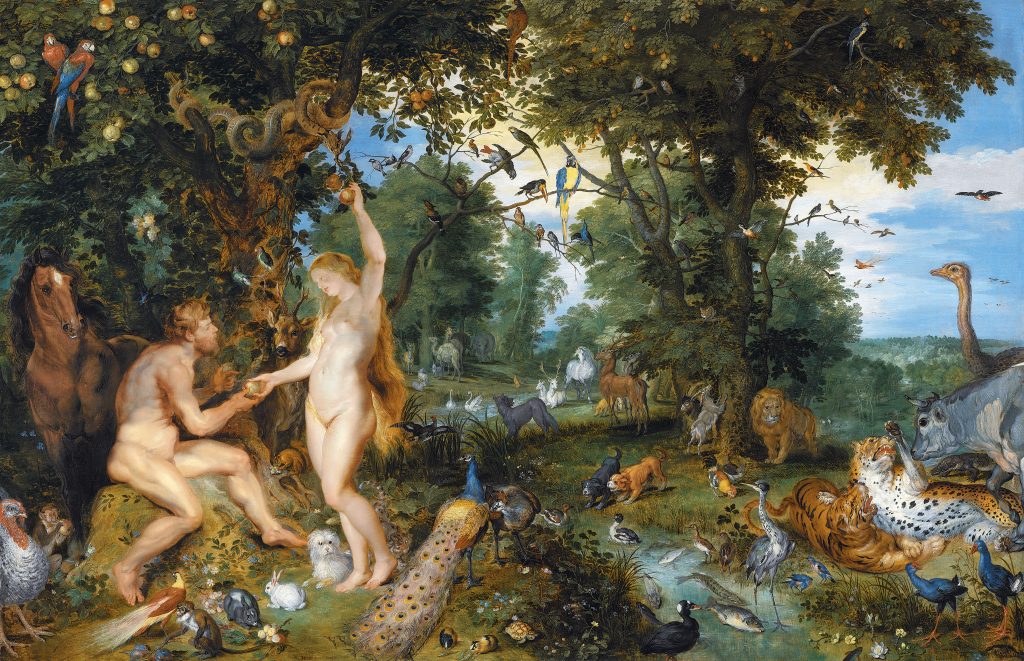
The Church has always taught that God created a first man (Adam) and a first woman (Eve) in his ‘image and likeness’. The name Adam is derived from the Hebrew word for “man” and Eve comes from the Hebrew for “life”, for it is through her that all human life originates. The Catechism tells us that our first parents were created in an original ‘state of holiness and justice’, meaning they were in friendship with God and in harmony with each other and creation around them (CCC375). As long as they obeyed God, they remained in friendship with him and were free from all suffering and death.
In Genesis, we learn that God gave Adam and Eve the freedom to eat from any tree of the garden, except one- the “tree of the knowledge of good and evil” (Genesis 2:17).
Because the creation story is written using figurative language, many of it’s descriptions have a symbolic meaning. For example, the Catechism states that the tree of knowledge of good and evil “symbolically evokes the insurmountable limits that man, being a creature, must freely recognize and respect with trust. Man is dependent on his Creator and subject to the laws of creation and to the moral norms that govern the use of freedom” (CCC396). Furthermore, our first parents eating of the forbidden fruit symbolizes humanity’s disobedience to God’s law and thus constitutes our first sin (Genesis 3:1-11).
After our first parent’s sin, God did not abandon us to sin and death. He sent his only Son who, through his death on the cross, not only makes amends for the sin of Adam and of the whole world, but renews all things in himself: “I have come that you may have life, and have it to the full” (John 10:10). Therefore, in a most glorious way, Christ’s inexpressible Grace has given us blessings better than those which sin has taken away from us (CCC412, 420). As St Thomas Aquinas writes, “There is nothing to prevent human nature from being raised up to something greater, even after sin’ (Summa Theologiae III, 1,3) It is Christ who restores that which was lost through original sin and raises us up to even greater heights by inviting us to share in His very life.
(Matthew Pinto and Jason Evert in ‘Did Jesus have a last Name’)
What is ‘Sin’ ?
Accordion Content
Eschatology – The Last Days
New Heavens and New Earth
In Isaiah 11 and later in the Book of Revelation, both Isaiah and St. John refer to the earth as having “four corners” (Isa 11:12; Rev 7:1). This was a common way of talking about the world because they saw the earth as an altar, a very specific altar: the altar God instructed Moses to build in Exodus. That altar had four corners, with a horn on each corner, and was where the Levitical priests offered sacrifices of atonement to the Lord (Exod 27:2).
What is the connection between the two, between the world as envisioned by Isaiah and John and the altar of the Old Testament? I think it will be made plain in the last days. During the time of the eschaton, we’re told that the Church, the Body of Christ, will undergo great trials, trials analogous in many ways to the trials that Jesus’s physical body underwent two thousand years ago. The Church will be beaten, bloodied, and mocked. Her members will suffer rejection, persecution, and martyrdom. Her priests will be imprisoned, tortured, and executed.
Then, finally, Jesus will come again. When he does, I believe he will say to all the priests being martyred, “Well done, good and faithful servants. You’ve done what you were asked to do. Now, step aside. It’s my turn.” Then, he will put his hands over the altar of the earth and say, “This is my Body.” But this time it won’t be bread and wine transubstantiated. It will be the heavens and the earth. It will be all the dust and all the bones of all the saints, in all the ages, which will be transubstantiated into the glorified Body of Christ.
Never forget: The Church is not a body metaphorically. The Church is a body metaphysically. And we’re not going to cease being members of that Body when we get our resurrected bodies. We are going to get a body like Jesus has a body. We are going to get resurrected, glorified bodies. But we’re also going to enter into an even deeper communion with the Body of Christ. We are going to be members of Christ’s body in a more real and more true way than my arms and legs are members of my body right now.
This is what St. Paul is getting at in 1 Corinthians 15— that the climax of all the Masses ever celebrated will be the eschaton, the parousia, the real presence of the Lord of Lords, in his body, and we will be part of that: We shall not all sleep, but we shall all be changed, in a moment, in the twinkling of an eye, at the last trumpet. For the trumpet will sound, and the dead will be raised imperishable, and we shall be changed. For this perishable nature must put on the imperishable, and this mortal nature must put on immortality. When the perishable puts on the imperishable, and the mortal puts on immortality, then shall come to pass the saying that is written: “Death is swallowed up in victory.” (1 Cor 15:51–54) At the eschaton, our bodies will be changed from perishable to imperishable.
The Body of Christ on earth will also be changed. All the things which mar her beauty in time—the sins and mistakes and foolish behaviour of her members—will fall away, and we will see the Church for what she truly is: Mother, Bride, and Body, perfected in glory.
The Second Vatican Council’s Lumen Gentium states: The Church, to which we are all called in Christ Jesus, and in which we acquire sanctity through the grace of God, will attain its full perfection only in the glory of heaven, when there will come the time of the restoration of all things. At that time the human race as well as the entire world, which is intimately related to man and attains to its end through him, will be perfectly reestablished in Christ.
Importantly, as the passage quoted above tells us, it’s not just our bodies and the Church that will be transformed at the end of time: It’s the entire world … and more. As the Catechism says, “the universe itself will be renewed” (CCC 1042). This “mysterious renewal” (CCC 1043) of all that exists in time and space is what Sacred Scripture refers to when it speaks of a “new heavens and a new earth” (2 Pet 3:13), and a “heavenly Jerusalem,” where the kingdom of God comes in its fullness and the God of all makes “his dwelling among men” (CCC 1044).
In this new, transformed universe, “he will wipe away every tear” (Rev 21:4), all pain, all sorrow, all mourning will cease, and God will share himself “in an inexhaustible way” with his children. This is what the Church calls “the Beatific Vision,” and it will offer to all those saved “the ever-flowing well-spring of happiness, peace, and mutual communion” (CCC 1045). Quoting St. Paul’s Letter to the Romans, the Catechism concludes: For the cosmos, Revelation affirms the profound common destiny of the material world and man: For the creation waits with eager longing for the revealing of the sons of God … in hope because the creation itself will be set free from its bondage to decay. … We know that the whole creation has been groaning in travail together until now; and not only the creation, but we ourselves, who have the first fruits of the Spirit, groan inwardly as we wait for adoption as sons, the redemption of our bodies.
The visible universe, then, is itself destined to be transformed, “so that the world itself, restored to its original state, facing no further obstacles, should be at the service of the just,” sharing their glorification in the risen Jesus Christ. (CCC 1046–47)
(Hahn, Scott; Stimpson Chapman, with Emily. Hope to Die: The Christian Meaning of Death and the Resurrection of the Body (pp. 60-62). Emmaus Road Publishing. Kindle Edition.)
Death and the Body Glorified
DEATH
At the moment of death, the soul leaves its body. While the body begins the long, slow process of decay, the soul immediately experiences the first judgment, usually referred to as our “particular judgment” (CCC 1022). In the particular judgment, we discover the consequences of the choices we made for or against Christ in our lifetime. If, during our earthly life, we accepted the graces of salvation offered to us, we learn that our eternal fate is heaven. Our eternal fate is God. If, however, during our earthly life, we rejected the graces of salvation, our eternal fate is hell. Our eternal fate is not God.
At this point, there are no do-overs. The time for choosing between God and not God ends when we leave this life. The judgment rendered against us is final. And that judgment is just.
Jesus Christ, the divine judge, sees all and knows all. He knows every drop of grace that was offered to us in every moment of our lives. He knows every circumstance that might have inhibited us from freely choosing grace. And he knows the deepest and truest desires of our heart. If the judgment rendered against us at the end of our days is hell, it’s because hell is what we chose. Hell is what we desire.
Those who said yes to the graces of salvation, those who choose God, go one of two places. Either they immediately enter the company of the blessed in heaven or they pass through a process of purification—purgatory—which will make it possible for them to eventually and fully enter into the joys of heaven.
Again, our eternal fate is decided at the moment of our death, in our particular judgment. But there is another judgment still to come: the Last Judgment. We are told that at the end of days “all the dead will rise,” and that “the hour is coming when all who are in the tombs will hear his voice and come forth, those who have done good, to the resurrection of life, and those who have done evil, to the resurrection of judgment” (CCC 998; John 5:29).
During this Final Judgment, everything you and I have ever done—good and bad—will be made known before all of humanity. Every secret sin, every secret good deed, will be secret no more. Everyone will see. Everyone will know. Then, after all the judgments have been rendered, the blessed and the damned alike will get their bodies back. For the damned, those bodies will increase their sorrow and pain. For the blessed, those bodies will increase their joy, enabling them to enter more fully into the glories of heaven.
THE BODY GLORIFIED
If you remember what we talked about in Chapter 2, you’ll recall that God didn’t design the human body and soul to be separated. He created the human person as a union of body and soul, and, had Adam never sinned, that unity would have remained intact. The separation that occurs at death is a consequence of original sin.
Jesus, by dying and rising again, opened up the path to reunification. Just as his body and soul were joined once more when he was resurrected, transformed, and glorified, so too will all the bodies and souls of all the just be reunited when we are resurrected, transformed, and glorified. The body that the soul rejoins will be your body—the same body reading these words right now—but it will also be different.
Most of the great Catholic minds who have wrestled with the questions surrounding the resurrection of our bodies have gone back to St. Paul’s words in 1 Corinthians 15, which is the fullest treatment on the subject Sacred Scripture gives us.
There Paul explains that the relationship between our earthly and heavenly bodies is like that of a seed to the wheat that grows from the seed: “And what you sow is not the body which is to be, but a bare kernel, perhaps of wheat or of some other grain” (1 Cor 15:37).
A thousand years later, St. Thomas Aquinas drew upon the work of the early Church Fathers to flesh out the Church’s most detailed reflection upon what these resurrected bodies of ours will be like. According to Aquinas, all resurrected bodies have three “conditions”—that is, identifiable traits—in common.
The first of these conditions is quality. Here, quality has two aspects. The first pertains to a specific attribute of the resurrected body: namely, sex. According to Aquinas, sex isn’t going away in heaven. If your body is male in this life, it will be male in the next. Likewise, if your body is female in this life, it will be female in the next. God created the human person male and female, and that’s how it’s going to stay.
There is another aspect to “quality,” though, and it has to do with the condition or shape the resurrected body will be in. Aquinas posited that no matter what age we die—at ninety-nine years old or nine minutes old—our resurrected bodies will all be resurrected at what he calls “the most perfect stage of nature.” That is to say, our bodies will be resurrected in the peak of their physical strength, health, and attractiveness.
The second condition common to all resurrected bodies that Aquinas named is identity, meaning your body will still be your body and you will still be you. The same soul you have now will once more be united to the same body (albeit resurrected and glorified) that you have now. This, however, doesn’t mean you will look exactly like you look now (or even how you looked at your “prime age”).
Remember, after Jesus’s Resurrection, his closest friends and family didn’t always recognize him. Sometimes they did. But sometimes they didn’t. Sometimes he looked like himself. Sometimes he didn’t.
Aquinas says the same will hold true for us. Fortunately, he adds, because it will be heaven, we won’t experience the difficulties the Apostles did when it comes to recognizing our friends and loved ones. God will make sure that we recognize Grandma Jane and Uncle Joe on sight, no matter how different their resurrected bodies might look from how we remember them.
That brings us to the third condition of our bodies to come: integrity. No matter what happens to your body in this life, in the next life it will be whole. People who lost limbs on earth will have those limbs back in heaven. People who couldn’t see or hear while they were alive on earth will see and hear in heaven. And people whose bodies were utterly destroyed in death, whose bodies were ravaged by fire, whose bones were crushed to dust, or whose whole physical selves were obliterated by a nuclear blast—all those people will have their bodies restored to them in their entirety in heaven. This is essentially what Tertullian meant when he wrote, “Any loss sustained by our bodies is an accident to them, but their entirety is their natural property. … To nature, not to injury are we restored.”
The first of these conditions is impassibility. Drawing upon St. Paul’s words about the resurrected body, “What is sown is perishable, what is raised is imperishable” (1 Cor 15:42), Aquinas interprets this to mean that the resurrected bodies of the blessed cannot grow sick, cannot feel pain, cannot age, and cannot die. They will be incorruptible, utterly exempt from the effects of illness, injury, or time. They also won’t be subject to bodily passions like lust or hunger, and will have no need to eat or engage in sexual intercourse.
The second condition of those resurrected to eternal life that Aquinas names is subtlety. This means that our bodies— while real, concrete, and present in space and time—will also possess a lightness that makes them almost ethereal. That doesn’t mean they will be able to walk through walls; that is a miracle. But, the heaviness of them that we experience in this life will be absent. We also will possess the power to fully communicate ourselves—our thoughts, feelings, the whole essence of who we are—to others. All the things in this life that make it difficult for us to understand others or share ourselves with others will disappear in the next.
The third condition listed by Aquinas is agility. So, the body that is “sown in weakness … is raised in power” (1 Cor 15:43). By agility, Aquinas doesn’t just mean our resurrected bodies will be more coordinated than they are on earth. He means they will be perfectly coordinated, in a way that the movements of the greatest athletes and the greatest ballet dancers can only hint at. Basically, our bodies will do whatever we want them to do, and they will do it perfectly: they will dunk basketballs, do pirouettes, leap tall buildings, and fly through the air. Every desire we have in this life—to move gracefully or swiftly, to soar through the sky or effortlessly float above it all—we have because that’s what our bodies were, in a sense, made to do. In heaven, we’ll be able to do it all with ease.
Agility also means we’ll be able to immediately realize other desires—to be where we want to be immediately, to see who we want to see immediately, to do what we want to do immediately. If you want to stand in a green meadow in heaven, all you will have to do is think that thought, and you’ll be there. If you want to see your great-great-great grandpa in heaven, you will … instantaneously, as soon as you want to see him. Essentially, your body will travel at the speed of your thoughts. It will be completely subject to your mind, not to the earthly laws of space and time.
(Hahn, Scott; Stimpson Chapman, with Emily. Hope to Die: The Christian Meaning of Death and the Resurrection of the Body (p. 67). Emmaus Road Publishing. Kindle Edition.)
Beatific Vision
When we finally enter into the Beatific Vision, we will understand why our days unfolded as they did, why we carried the crosses we did, and why we experienced the blessings we did. We also will see why we made the choices we did, what graces God gave us, and what spiritual battles took place around us while we ate and slept and worked and prayed. In heaven, our lives—the everlasting whole of them— will make sense to us. We won’t question why something unfolded as it did or feel like we got short-changed or wonder how God could have asked us to endure certain crosses. We will know and see it all, and we will think it perfect, from first to last, recognizing how there wasn’t a moment lost or wasted and how even the tragedies of our life contribute to the joy and beauty of heaven.
In a sense, it’s like all of our lives and all of time form a symphony that no human could write and no master musician could perform. And when we hear that symphony in heaven, we will understand how all the dark experiences, all the tragedies, all the minor chords and dissonant sounds contributed something important, making the whole greater and more beautiful than the sum of its parts.
(Hahn, Scott; Stimpson Chapman, with Emily. Hope to Die: The Christian Meaning of Death and the Resurrection of the Body (p. 71). Emmaus Road Publishing. Kindle Edition.)
- Transsubstantiation / Eucharist
- Trinity
- Papal infallibility, pastor aeternus
- Mariology